
The LisbOn KInetics (LoKI) Suite
Tools
The LisbOn KInetics (LoKI) Suite comprises a collection of simulation tools mostly intended for plasma chemistry studies.

The LoKI-Suite tools and data leverage the expertise in the field of non-equilibrium low-temperature plasmas accumulated over many years by the Portuguese group N-Plasmas Reactive: Modelling and Engineering (N-PRiME).
Their development has been guided by four main principles:
- adoption of an ontology that prioritizes a clear separation between tools and data;
- flexibility to host any plasma chemistry scheme, covering both volume and surface mechanisms and allowing a full state-to-state description;
- consistency in the coupling between electron kinetics and heavy-species kinetics, particularly in determining the discharge characteristic;
- clarity in defining the working conditions relevant for comparing simulations results with experimental measurements.
This pages presents the following LoKI-Suite tools
- The LisbOn KInetics Global Model (LoKI-GM)
- The LisbOn KInetics Global Model workflow
- The LisbOn KInetics Monte Carlo (LoKI-MC)
- The LisbOn KInetics Boltzmann solver in C++ (LoKI-B++)
After downloading a LoKI Suite tool, and especially if you intend to interact with us, you are invited to send a short message
to: loki@tecnico.ulisboa.pt
with subject: LoKI-XX (XX = GM, B, MC, ...)
just giving your name and affiliation.
Also, you are much welcome to report any problem or bug you may find using the code, or to send any feedback with suggestions for further developments.
LoKI-GM
Available HERE as open-source software, licensed under the GNU general public license 3.0.
LoKI-GM was officially launched during the 27th Europhysics Conference on Atomic and Molecular Physics of Ionized Gases (ESCAMPIG 2026), held in Funchal, Madeira.See here a copy of the presentation
The LisbOn KInetics Global Model (LoKI-GM) framework comprises two modules, which can run self-consistently coupled or as standalone tools:
- a Boltzmann solver (LoKI-B) for the electron Boltzmann equation;
- a Chemical solver (LoKI-C) for the global kinetic model(s) of pure gases or gaseous mixtures.
The supported input/output formats comprise both graphical user interfaces (GUI) and text-based files in ASCII, JSON and HDF5. In the HDF5 format, all output data are stored in a single, structured file. This file can be accessed and post-processed using Python scripts, through one of the available HDF5 interfaces, or by applying appropriate import filters in data analysis tools such as MATLAB or Origin.
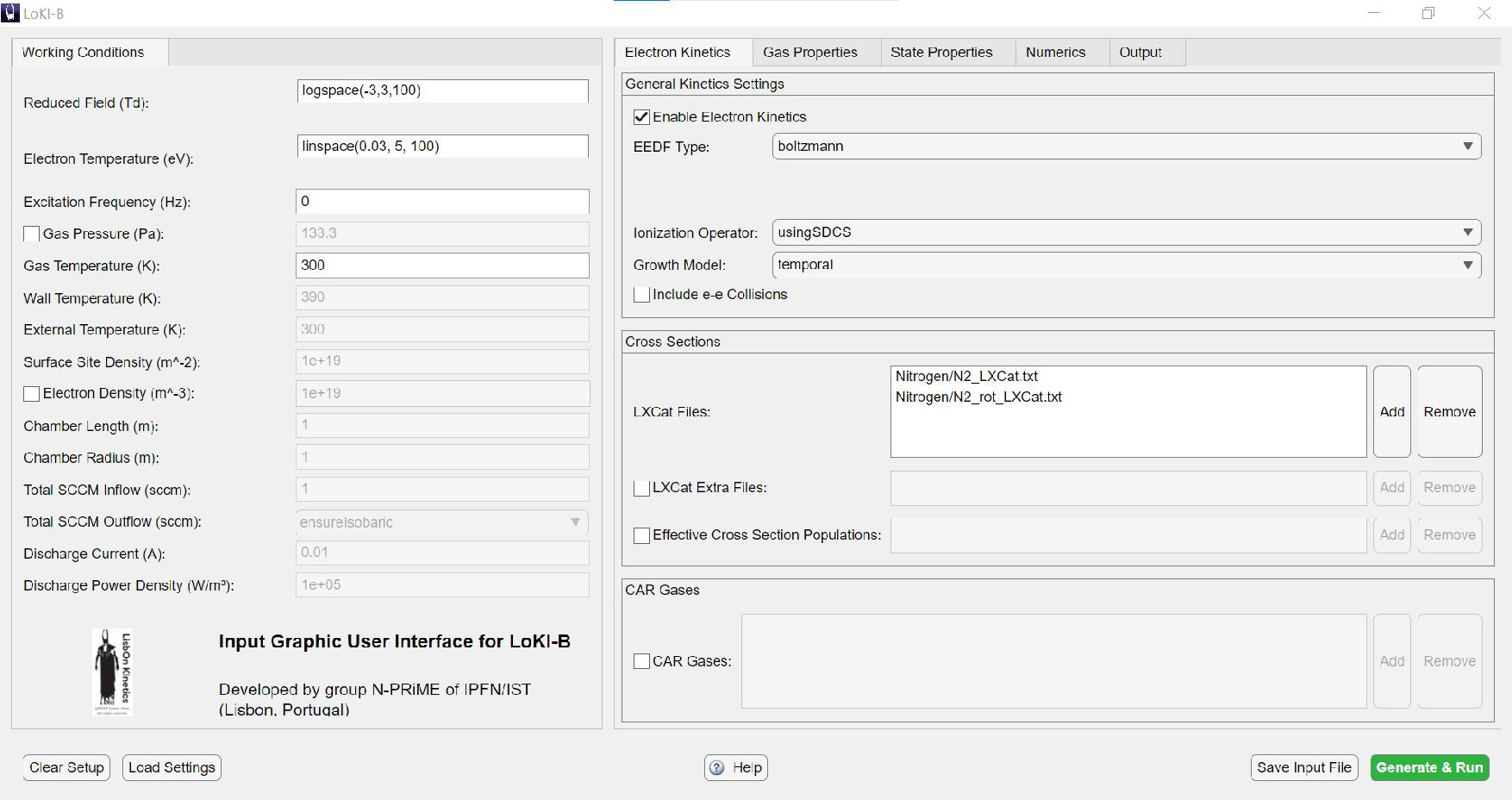
LoKI-B solves the space independent form of the two-term electron Boltzmann equation to calculate the isotropic and the anisotropic parts of the electron distribution function, and the associated electron macroscopic parameters. LoKI-B applies to non-magnetised non-equilibrium low-temperature plasmas, excited by DC/HF electric fields or time-dependent (non-oscillatory) electric fields from different gases or gas mixtures. The tool uses a stationary description for DC fields, a Fourier time-expansion description for HF fields, and a time-dependent description for time-varying fields.
LoKI-B was developed as a response to the need of having an electron Boltzmann solver easily addressing the simulation of the electron kinetics in any complex gas mixture (of atomic / molecular species), describing first and second-kind electron collisions with any target state (electronic, vibrational and rotational), characterized by any user-prescribed population. LoKI-B includes electron-electron collisions, it handles rotational collisions adopting either a discrete formulation or a continuous approximation, and it accounts for variations in the number of electrons caused by non-conservative events (ionization and attachment) by adopting by adopting either a space-homogeneous exponential temporal growth or a time-constant exponential spatial growth of the electron density.
LoKI-B features the following:
(i) electron kinetics stationary simulations (including swarm analysis), for discrete value(s) of E/N;
(ii) electron kinetics time-dependent simulations, for E/N specified as a time-dependent (non-oscillatory) function;
(iii) the calculation of the first anisotropy component of the electron distribution function;
(iv) the prescription of populations to manage the effective momentum-transfer cross section;
(v) the possibility of considering anisotropic effects in inelastic electron collisions, namely in rotational events, by resorting to momentum-transfer cross sections;
(vi) the definition of a generalized Maxwellian EEDF as possible output;
(vii) a Graphical User Interface - based input.
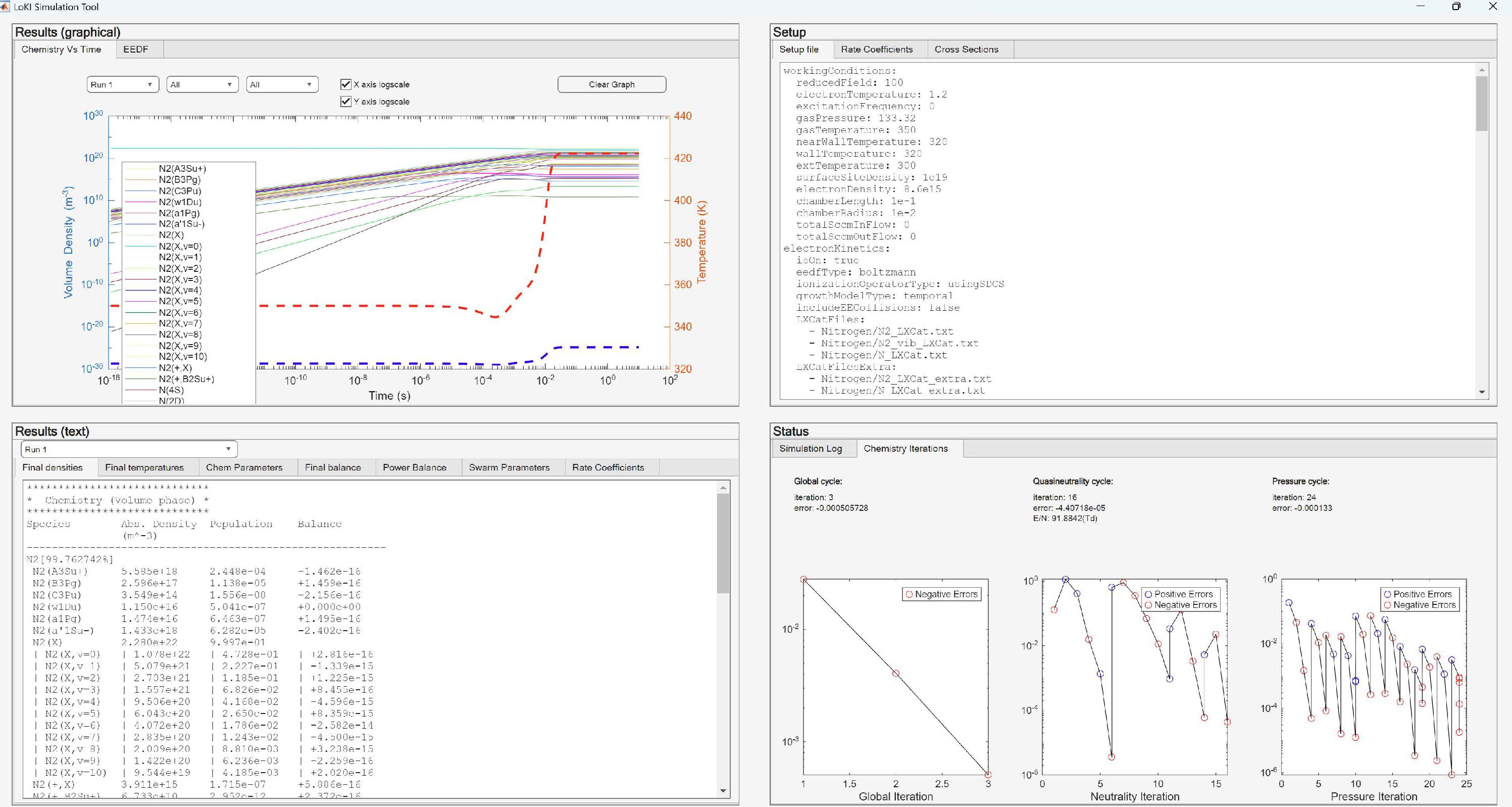
LoKI-C solves solves the system of zero-dimensional (volume average) rate balance equations for the main charged and neutral species in the plasma. LoKI-C receives as input data the kinetic schemes (KITs) for the gas/plasma/surface system under study, via an intuitive csv-like input file, and gives as output the particle densities of the different gas/plasma/surface species, the corresponding creation/destruction reaction rates, and the reduced electric field (and any related quantity, such as the discharge current or the discharge power-density).
LoKI-C features the following:
(i) it uses several modules to describe the mechanisms (collisional, radiative and transport) controlling the creation/destruction of species, namely various transport models for the charged particles (ambipolar diffusion, effective diffusion, and Liberman and Lee's low-pressure model) and for the neutral particles (multi-component diffusion of species following Wilke's approach, and considering wall recombination);
(ii) it includes a gas/plasma thermal model, for the self-consistent calculation of the gas temperature;
(iii) it supports multi-component mean-field microkinetic mesoscopic models to handle surface kinetics in a fully coupled way with volume kinetics;
(iv) quasi-stationary simulations, accounting for the prescribed temporal evolution of the electric field (or any related quantity, such as the discharge current or the discharge power-density). In this case, LoKI-C uses precomputed lookup tables of electron macroscopic parameters to interpolate, at selected time instants and as a function of E/N (local field approximation) or &epsilon: (local mean energy approximation), the corresponding electron transport parameters, rate coefficients and power transfer.

LoKI-GM workflow
See here a home video by Duarte Gonçalves on his MSc thesis and the LoKI-GM workflow.
LoKI-B and LoKI-C can run coupled together or as standalone tools.
The general input to the code specifies the working conditions, including the applied reduced electric field and frequency, gas pressure and temperature, electron density (or a related quantity such as discharge current or power density), and, when considering gas mixtures, the species fractions and state populations of the different components, both in the gas phase and at surfaces.
For LoKI-B, the input data additionally comprise the population distributions of the electronic, vibrational, and rotational states of the atomic/molecular species considered (determined self-consistently when coupled with LoKI-C), as well as the relevant sets of electron-scattering cross sections obtained from the open-access database LXCat.
For LoKI-C, the required inputs further include the geometrical dimensions of the plasma reactor, gas inflow/outflow conditions, wall/external temperatures relevant to the gas/plasma thermal model, the surface site densities when a microkinetic mesoscopic surface model is employed, and the rate coefficients for all reactions considered in the kinetic scheme, including the electron rate coefficients evaluated in LoKI-B.
As output, LoKI-B provides the isotropic and anisotropic components of the electron distribution function, the corresponding electron macroscopic parameters (transport parameters and rate coefficients), and the electron power absorbed from the electric field and transferred to the various collisional channels.
LoKI-C yields the densities of states and the reaction rates associated with the processes included in the kinetic scheme. In a coupled configuration, LoKI-B supplies the electron macroscopic parameters to LoKI-C. These parameters are then used to solve the system of nonlinear, spatially-averaged rate balance equations, together with the gas/plasma thermal balance equation, based on the specified kinetic scheme for the gas/plasma system.
LoKI-GM supports three main types of plasma chemistry simulations, schematically shown in the general workflow of the figure below.

- steady-state simulations, in which LoKI-C and LoKI-B are run in a coupled manner. In this framework, LoKI-C updates, at steady-state, the values of the reduced electric field, the populations of the various heavy species and the gas temperature, which are then supplied to LoKI-B for the solution of the electron kinetics. The numerical workflow involves the following iterative cycles:
- the pressure cycle (optional), running within LoKI-C to ensure calculations at constant gas-pressure, specified by the user;
- the neutrality cycle, coupling LoKI-C to LoKI-B, to ensure calculations at constant electron density (or any related quantity, such as the discharge current or discharge power density);
- the global cycle, coupling LoKI-C to LoKI-B, to converge over the populations of the heavy species considered in the solution of the electron Boltzmann equation.
- quasi-stationary simulations, in which LoKI-C runs as a standalone tool. In this framework, the code calculates the time-dependent populations of the various heavy species, while accounting for the prescribed temporal evolution of the electric field (or any related quantity, such as the discharge current or the discharge power-density), specified by the user. In this case, LoKI-C uses precomputed lookup tables of electron macroscopic parameters to interpolate, at selected time instants and as a function of E/N (local field approximation) or ε (local mean energy approximation), the corresponding electron transport parameters, rate coefficients and power transfer.
- post-discharge simulations, in which LoKI-GM first computes the corresponding steady-state solution, determining the species densities and the gas temperature, and then sets the inelastic/superelastic electron rate coefficients to zero (corresponding to a condition with E/N = 0), and integrates in time the system of rate balance equations.
When coupling electron kinetics with chemical kinetics, LoKI-GM adopts the following closure conditions:
- it imposes charge neutrality, determining the electron density from the corresponding ion balance equations, instead of solving the electron particle balance equation;
- for consistency, it relies on the solution of the homogeneous electron Boltzmann equation to obtain information on the electron power distribution, instead of integrating an electron energy balance equation.
For more information about LoKI-B and to give proper credits to the main developers, please use the following references
- A. Tejero-del-Caz, V. Guerra, D. Gonçalves, M. Lino da Silva, L. Marques, N. Pinhão, C. D. Pintassilgo and L. L. Alves
The LisbOn KInetics Boltzmann solver
Plasma Sources Science and Technology 28 043001 (2019) - A Tejero-del-Caz, V Guerra, N Pinhão, C D Pintassilgo and L L Alves
On the quasi-stationary approach to solve the electron Boltzmann equation in pulsed plasmas
Plasma Sources Science and Technology 30 065008 (2021)
For more information about LoKI-GM and to give proper credits to the main developers, please use the following reference
- L. L. Alves, A. Tejero-Del-Caz, L. Marques, P. Pereira, N. Pinhão, C. D. Pintassilgo, T. Silva, P. Viegas and V. Guerra
LoKI-GM: a global model framework for plasma chemistry studies
Plasma Sources Science and Technology, submitted (2026)
arXiv
LoKI-MC
Available HERE as open-source software, licensed under the GNU general public license 3.0.
The LisbOn KInetics Monte Carlo (LoKI-MC) solves the electron kinetics for low-temperature plasmas excited by uniform DC electric fields from different gas mixtures, using Monte Carlo techniques.
LoKI-MC is written in C++, benefiting from a highly-efficient object-oriented structure.
Following the strategy and data organization of the LisbOn KInetics Boltzmann solver (LoKI-B), the code easily
addresses any complex mixture of atomic/molecular species, describing electron collisions with any target state (electronic, vibrational and rotational), characterized by any user-prescribed population.
On input, the code requires the working conditions, the gas-mixture composition, the distributions of populations for the levels of the atomic/molecular gases considered, and the relevant sets of electron-scattering cross sections obtained from the open-access website LXCat. On output, it yields the electron energy and velocity distribution functions, the electron swarm parameters, the collision rate-coeffcients, and the electron power absorbed from the electric field and transferred to the different collisional channels.

For more information about LoKI-GM and to give proper credits to the main developers, please use the following reference
- T. C. Dias, A. Tejero-del-Caz, L. L. Alves and V. Guerra
The LisbOn KInetics Monte Carlo solver
Computer Physics Communications 108554 (2022)
LoKI-B++
Available HERE as open-source software, licensed under the GNU general public license 3.0.
The LisbOn KInetics Boltzmann solver LoKI-B++ is a C++ counterpart of MATLAB's LoKI-B, replicating essentially all of its original features.
LoKI-B++ is written in C++, taking advantage of the higher performance of a compiled language, and linked with Eigen, a C++ template library for linear algebra.